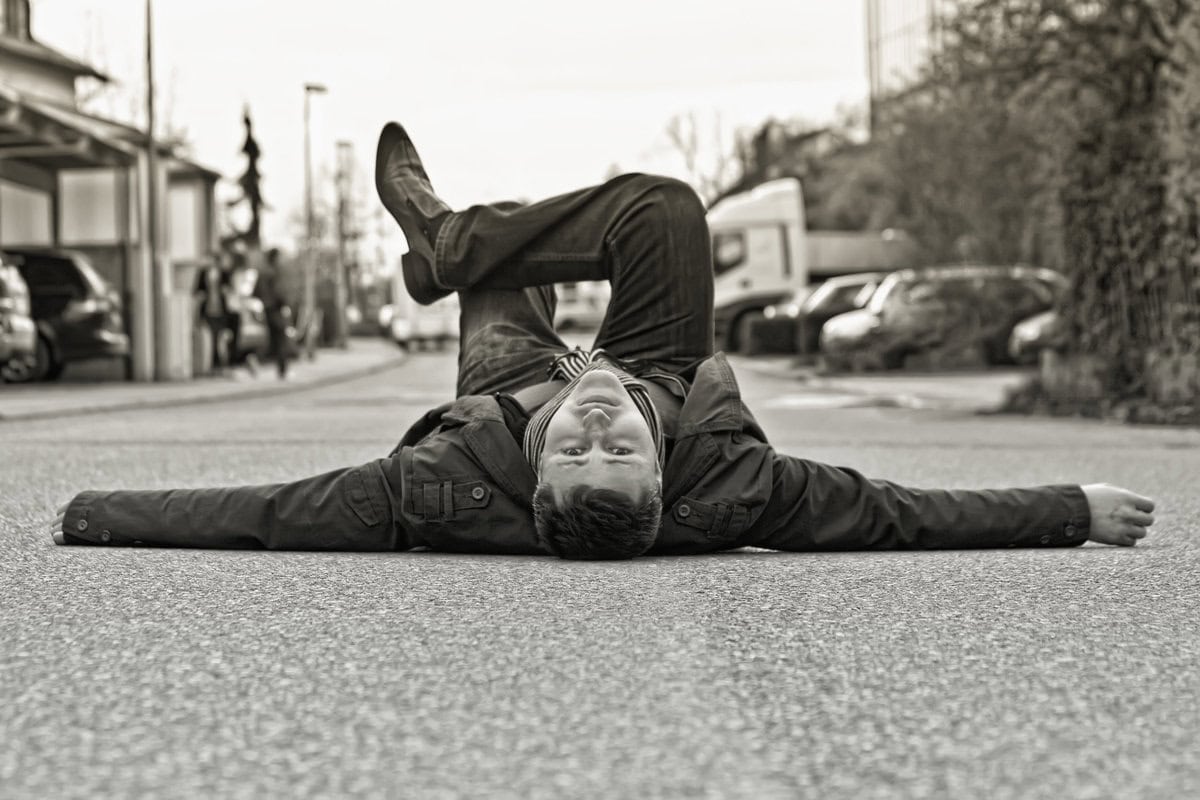
Today is a favorite American holiday—Labor Day. It marks the end of summer and has no obligatory gift-giving, laborious feasts to prepare, or time-consuming official parades and celebrations. We often think of it as a holiday of rest—to just relax and do nothing except maybe cook out, hang with friends and family, or have a last hoorah at the beach. The holiday came out the labor movement in the 1930s to honor the worker with a day off.
[caption id="attachment_1805" align="alignright" width="225"] Me--practicing Skill #16 on Labor Day weekend--I wish you could hear the creek babbling in the background.[/caption]
Rest. I’ve really struggled with that in my own head the last couple of weekends. I’ve had few social obligations. While there are always house tasks to complete, I haven’t felt particularly compelled to do any. At all. My back-to-school weeks have been long and busy. It’s been particularly hot for about a month. I’m tired. Consequently, I’ve logged much more “couch time” than I typically might. I’ve rested.
The struggle? That voice inside that says, “Shouldn’t you get up and do something productive?” Then the arguing begins, “No. I’m tired. It’s OK to rest.” The truth? I deserve to rest.
Merriam-Webster defines rest as “a bodily state characterized by minimal functional and metabolic activities,” and secondly as “freedom from activity or labor, or a state of motionlessness or inactivity.” A final definition is “peace of mind or spirit.” I really like that representation. Rest is synonymous with Relax, which is defined as “to become lax, weak, or loose; or to become less intense or severe. Sounds like that peace again—of mind, body and spirit.
I don’t watch much television for many reasons but I also don’t disparage those who do. In fact, I think the idea of collapsing at the end of the day in a recliner to simply be entertained is probably useful—assuming one is not neglecting things more essential. TV might be our culturally accepted version of rest. My greatest concern, however, is the content of what people are watching: when I do flip channels at night, much of what I see are crime shows with intense violence. Given what we know about the release of stress hormones in the face of fear and horror, it is difficult for me to believe that this is restful for either our bodies or our minds, much less our spirit! To truly rest, we need to separate ourselves from extraneous stimulation and practice letting go of the outside world.
To truly rest, we need to separate ourselves from extraneous stimulation and practice letting go of the outside world.
Early in the 1980s, I was fairly serious about weight lifting. While less understood then, it has become more common knowledge that rest is required to build muscles. At that time, there was a guy in our gym, daily working every muscle group and loudly lamenting that he never seemed to get bigger. Some of us at the time recognized his mistake but he could not be convinced by anyone, so his progress was curtailed. The adage now is “Muscles are torn in the gym, fed in the kitchen, and built in the bed.” We need rest.
The gym example is a clear symbolic representation of what happens in other aspects of our life too. People so often say they “need to stay busy” but might actually be outrunning spiritual or emotional growth. Not all cultures operate like this. For example, it is unthinkable in the U.S. that a business would close for a few hours every afternoon for siesta as was originated in Spain and practiced in certain Spanish-influenced cultures of South America along with others on the Mediterranean and in hot climates. But then there is also this Spanish proverb: How beautiful it is to do nothing, and then rest afterward.Sadly, we are not a culture that values rest and repose like some others. Eastern traditions, for example, value time spent in a meditative state. When I suggest meditation to some clients, especially the ones who could truly benefit from that practice, I hear, “Oh, I could never sit still that long.” “I’m better off when I am busy.” But we’re not. The burgeoning research on meditation clearly demonstrates that our minds, bodies, and spirit require restorative time. Simply put—it is good for us to rest.
[bctt tweet="It is good for us to rest our bodies, minds and spirit. --LiM2"]
British Baron and young childhood friend of Charles Darwin, John Lubbock, said, “Rest is not idleness, and to lie sometimes on the grass under the trees on summer’s day listening to the murmur of water, or watching the clouds float across the sky is by no means a waste of time.” It is in these still, restful moments in nature when we have the opportunity to connect with the Divine. I can assure you, it will not be when we are running errands, in loud crowds, or when our heads are filled with chatter or lists. We must create the space for this kind of joy and not crowd it out.
“Busyness”, blurred boundaries between work and personal time, perfectionism, overachieving, and technological distractions are a few excuses that delude us into thinking we can’t just stop. Mark Twain said, “If you have no time to rest, it’s exactly the right time.”
So I’m going to keep this one short and go back to my task of not laboring this weekend and get some more rest because Life is Messy and Life is Marvelous!
Last week, I was in the grocery store and found myself quite surprised and feeling discouraged at the number of shoppers without masks—particularly those who were elderly and obviously rather frail. As Covid numbers rise, I am shocked that some people are in denial about the numbers. As a psychologi
Ring the bells you still can ring; forget your perfect offering. There is a crack in everything; that's how the light gets in. Leonard Cohen A Story About Cracks and Flaws Let me tell you an ancient story about cracks and flaws. It is about a girl whose morning chore was to walk to the river and fet
Have you ever heard a piece of music that made you cry? I find myself completely inspired by music and those who produce it in any way. Music is the universal language. There is not a culture in existence that does not make music in some way.